Threat Modeling (TM) vs. Security Design Reviews (SDR)
Author: Sandesh Mysore Anand

If you've spent any time in AppSec, you've probably heard Threat Modeling (TM) and Security Design Reviews (SDR) used interchangeably. I know I have. Sometimes they're treated as synonyms. Sometimes SDRs are described as "lightweight threat models." Sometimes threat modeling is positioned as an advanced form of design review.
The definitions aren't wrong. The framing is.
SDR is, in many ways, a specialized form of threat modeling. Both activities analyze representations of a system and surface security concerns. But treating them as interchangeable causes real problems. Teams either overload engineers with open-ended security debates when a focused review would suffice, or they reduce deep risk analysis into shallow checklists when the situation actually calls for broader threat exploration.
Understanding where SDR fits within the broader TM umbrella, and more importantly, when to use which approach, is what separates AppSec programs that scale from those that burn out their teams or miss critical risks.
The confusion usually starts because TM and SDR share the same intellectual roots.
What is the common starting point
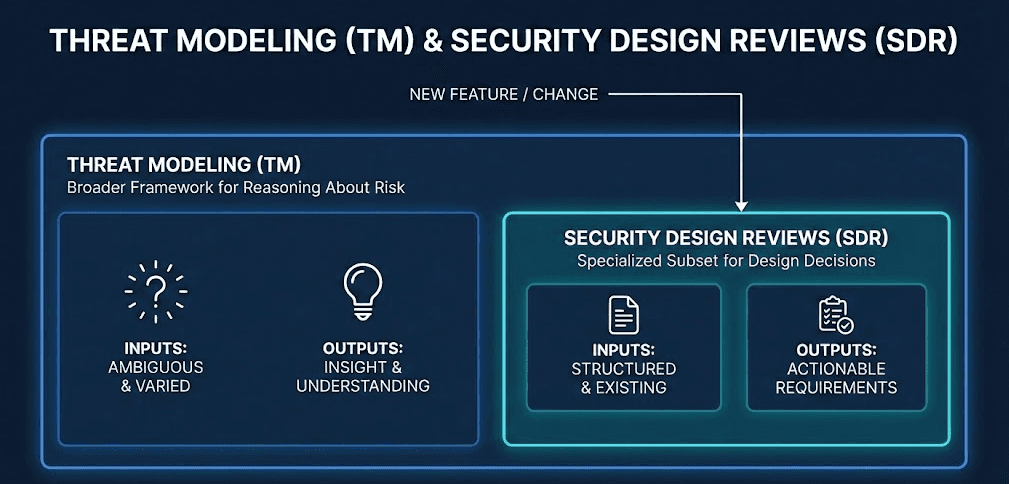
Both TM and SDR originate from the same foundational idea, best captured by The Threat Modeling Manifesto:
Analyzing representations of a system to highlight concerns about security and privacy characteristics.
That definition packs three important ideas. "Representations of a system" means diagrams, designs, code, data flows, and mental models. "Concerns about security and privacy" means we're talking about risk, not any software bugs. And "highlight" means surface, not necessarily solve.
This shared origin is why teams conflate TM and SDR. But once you move past the definition and into practice, there's one question that separates them cleanly:
What decision is this activity trying to enable, and for whom?
That's it. That question alone will save you hours of semantic debates.
When do they happen in the SDLC
Threat Modeling is not tied to a single SDLC phase. You can (and should) use a threat model during early design, mid-build when implementation details emerge, before a penetration test, after an incident, or while reviewing a legacy system no one fully understands anymore. We all have these, let's be honest.
In fact, good pen testers almost always build an implicit threat model before testing. They ask: What's exposed? Where are trust boundaries? What would I attack first?
TM exists to help security thinkers reason about attacker behavior and system exposure. Timing is flexible because understanding risk is always valuable.
SDRs are different. They are design-stage controls by definition. Their job is to influence what gets built, not just how it might be attacked later. An SDR typically happens when a new system or feature is proposed, when a material architectural change is introduced, or when new data types, integrations, or trust boundaries are added.
If you're reviewing code changes only, you're already late. SDRs work on the principle that there's still time to change direction.
I think about the difference this way: TM helps security thinkers reason about attackers. SDRs help builders make better decisions before those decisions harden into code.
What are the inputs
Threat Modeling: "All the information you have"
There is no natural input for TM. Depending on scope and timing, inputs might include interviews with engineers, architecture diagrams (current or outdated, usually outdated :P), source code, API specs, operational knowledge, even tribal memory.
TM adapts to ambiguity. In fact, ambiguity is often the point. It reveals where understanding is thin. That flexibility is great, but it's also why TM is hard to standardize and scale. You can't templatize "talk to people and figure out what's going on."
SDRs: What teams already produce
SDRs intentionally anchor to existing artifacts: PRDs, design docs, architecture diagrams, tech specs, and the current codebase when relevant.
SDRs work because they ride the same rails as engineering workflows. They don't ask teams to produce new abstractions just for security. They meet teams where they already are.
This is a big deal. If you've ever tried to get engineering teams to draw Data Flow Diagrams specifically for security reviews, you know the adoption pain. SDRs sidestep that entirely.
What are the outputs
Threat Modeling: Understanding, not instructions
TM outputs vary wildly depending on methodology and scope. You might end up with lists of threats, attack trees, risk narratives, annotated diagrams, or abuse cases. Using STRIDE yields different artifacts than PASTA. A lightweight whiteboard session looks nothing like a formal workshop.
And that's okay, because the goal is insight. Threat Modeling answers questions like: What could realistically go wrong here? Which attack paths matter most? Where are we exposed in ways we didn't expect?
It sharpens security intuition. It does not necessarily tell engineers what to implement next. This is where many (not all) threat modeling initiatives fall apart.
The engineers walk away saying, "Okay, but what do I do now?"
SDR Outputs: Clear, actionable security requirements
SDRs produce something much more constrained and operational. Things like: authentication must be enforced at service boundaries, not the gateway. Secrets must be sourced from the platform secret manager. PII must be encrypted at rest using approved key management. This service must emit audit logs for these events.
They're not expressed as threats, but as explicit design decisions or security requirements teams should implement. A good SDR output is unambiguous, clarifies the why, maps directly to implementation, and can be validated later.
Automation: SDR scales easily (thanks, AI).
Why Threat Modeling is hard to automate
TM struggles with automation for structural reasons. There's no universal definition of "done." Outputs vary by methodology. Diagramming is central and subjective. Human judgment is the core value.
You can assist Threat Modeling with tools, but full automation misses the point. The exercise is about thinking, not just the conclusion.
I know this sounds like something a Luddite would say (Far from it, I run an AI company), but I genuinely believe TM's value comes from the conversation, not the artifact.
Why SDR automation is now feasible
SDRs are input-constrained, output-structured, and decision-oriented. This makes them a strong fit for LLMs. Modern systems can read design artifacts, understand architectural intent, apply security policy contextually, and produce consistent, explainable requirements. Here, automation doesn't remove judgment. It enables better decision-making at scale.
What do mature orgs do
Here's the pattern I've seen mature AppSec orgs move towards: 100% SDR coverage for all changes (every team, every time, without heroics) combined with targeted Threat Modeling for high-risk systems, novel architectures, major trust boundary shifts, and incident-driven retrospectives.
In many cases, SDRs act as the filter: if an SDR flags an elevated or unclear risk, escalate to threat modeling. If not, proceed with confidence.
This flips the common anti-pattern on its head. Instead of threat modeling everything (and burning out your security team), you use SDRs to decide when deep modeling is warranted.
Is there a practical decision matrix
Depending on your company's workflow, a good way to think about this is: run an SDR for every meaningful change, but TM happens only when certain criteria are met.
In other words, one output of an SDR is to determine whether a deeper threat model is even necessary. SDRs become the triage mechanism that prevents your security team from drowning in full-blown Threat Modeling sessions for routine work.
Here's an example of how such a framework might look, though the specific triggers will vary based on your organization's risk appetite, team capacity, and the nature of what you're building:
Situation | What to Do | Why |
Routine feature change | Run an SDR | Validate decisions efficiently |
New integration or data type | SDR first | Establish requirements early |
Design ambiguity or disagreement | Escalate to TM | Shared understanding needed |
Novel or high-risk architecture | TM explicitly | Unknown attacker paths dominate |
Post-incident or pre-pen test | TM | Maximize learning |
How does this work in practice
Let me give you a concrete example. A SaaS team introduces a new feature syncing customer data to a third-party analytics service. An automated SDR is triggered using the existing PRD and design doc.
Most controls look standard, but assumptions around cross-tenant isolation are unclear and need further review. Rather than forcing premature requirements (or, worse, handwaving the risk away), the AppSec team escalates to a focused threat-modeling session.
That session surfaces a lateral movement path no one had considered. With this understanding, the team returns to the SDR, refines requirements, and proceeds with confidence.
Each practice does exactly the job it's meant to do. No overlap, no gaps.
In conclusion
If you run an AppSec program, aim for 100% SDR coverage for meaningful changes and targeted threat modeling for high-risk or ambiguous scenarios.
And remember: Threat Modeling is stage-agnostic because it optimizes risk understanding. Security Design Reviews are design-bound because they optimize decision-making.
SDR lives within the TM family, but conflating them leads to processes that either do too much or too little.
Once you internalize that distinction, everything else (timing, inputs, outputs, automation, scale) falls into place.