Back to Whitepapers
Regulation & Compliance
Cross-Industry
The EU Cyber Resilience Act is Forcing a New Security Operating Model
Examines what the CRA actually requires, where existing security programs structurally fall short, and what an operational model for compliance looks like in practice.
By: Kabir Mulchandani
Executive Summary
The EU Cyber Resilience Act (CRA) changes the question regulators are asking. Not "does your organization have a security program?" but "can you prove this product was designed securely?"
That is a different question and most organizations cannot answer it. The structural failure is not one of intent. Security teams understand threat modeling. Developers understand secure coding practices. The failure is one of timing, consistency, and traceability.
Security reviews in most organizations happen after architectural decisions are committed, run inconsistently across features, and leave no durable audit trail. Under prior frameworks, this was an operational imperfection. Under the CRA, it is a compliance gap with go-to-market consequences.
The CRA imposes product-level accountability. Every product with digital elements sold into the EU market must demonstrate security-by-design, maintain documented evidence of architectural security decisions, sustain vulnerability handling across its full support lifecycle, and produce technical documentation available to market surveillance authorities on request.
Existing AppSec tools: SAST, DAST, and pen-testing don’t satisfy this requirement. These tools operate after the security decisions that mattermost have already been made.
This whitepaper examines what the CRA actually requires, where existing security programs structurally fall short, and what an operational model for compliance looks like in practice.
Why the CRA Exists and Why It Matters Beyond Compliance
The Cyber Resilience Act addresses a gap that earlier cybersecurity frameworks left largely untouched: the security of the product itself.
For years, connected products have reached mass deployment without a consistent or enforceable security baseline. As software became embedded in infrastructure, business operations, consumer devices, and industrial environments, the market expanded far faster than the accountability mechanisms governing how securely those products were designed. In many cases, decisions made during architecture and product definition had broad security consequences long before any code was written or tested.
The Mirai botnet remains a clear example of the failure the CRA is designed to address. In 2016, hundreds of thousands of internet-connected devices were compromised and used in one of the largest DDoS attacks of its time. The root cause was not an advanced exploit. It was a product security decision: devices shipped with identical default credentials across every unit, publicly documented, with no manufacturer mechanism to update or revoke them remotely.
This is the kind of risk the CRA brings into focus. Some of the most consequential security failures originate in product design, authentication models, trust boundaries, and default behavior. By the time these issues are visible in testing, they are often already built into the product.
The CRA introduces a product-level accountability model in which security by design is no longer a recommended practice or an internal aspiration.
Why Non-EU Organizations Cannot Treat This as a Regional Matter
One of the most common early misunderstandings about the CRA is treating it as a European issue for European companies. It is not.
The regulation applies to any organization placing products with digital elements on the EU market, regardless of where it is based. If a product is made available to customers in the EU, obligations may apply depending on how it is placed or distributed.
More importantly, the CRA is unlikely to remain confined to legal scope. General Data Protection Regulation (GDPR) provides a useful precedent. Its impact extended well beyond enforcement because it changed procurement expectations, customer due diligence, and the baseline standards enterprises applied to software vendors.
The CRA is likely to follow the same path. Even before formal applicability is fully assessed, its effects begin to appear in commercial workflows. Security questionnaires shift. Procurement teams ask more specific questions. Customers expect clearer answers on how security is addressed at the design stage, how vulnerabilities are handled across the product lifecycle, and what evidence supports those claims.
For that reason, treating the CRA as a narrow legal or regional requirement is a mistake. In practice, it is a product and go-to-market concern. The impact will extend beyond compliance teams to engineering leadership, product security, AppSec, and the groups responsible for how products are designed, developed, tested, and shipped.
What Makes This Regulation Structurally Different
The CRA is often discussed alongside NIS2, DORA, ISO 27001, and SOC 2, but it operates at a different level.
Those frameworks assess how an organization manages security: governance, controls, resilience, and security management practices. The CRA evaluates the product itself: how it was designed, how it behaves, how it is maintained, and whether those decisions can be evidenced.
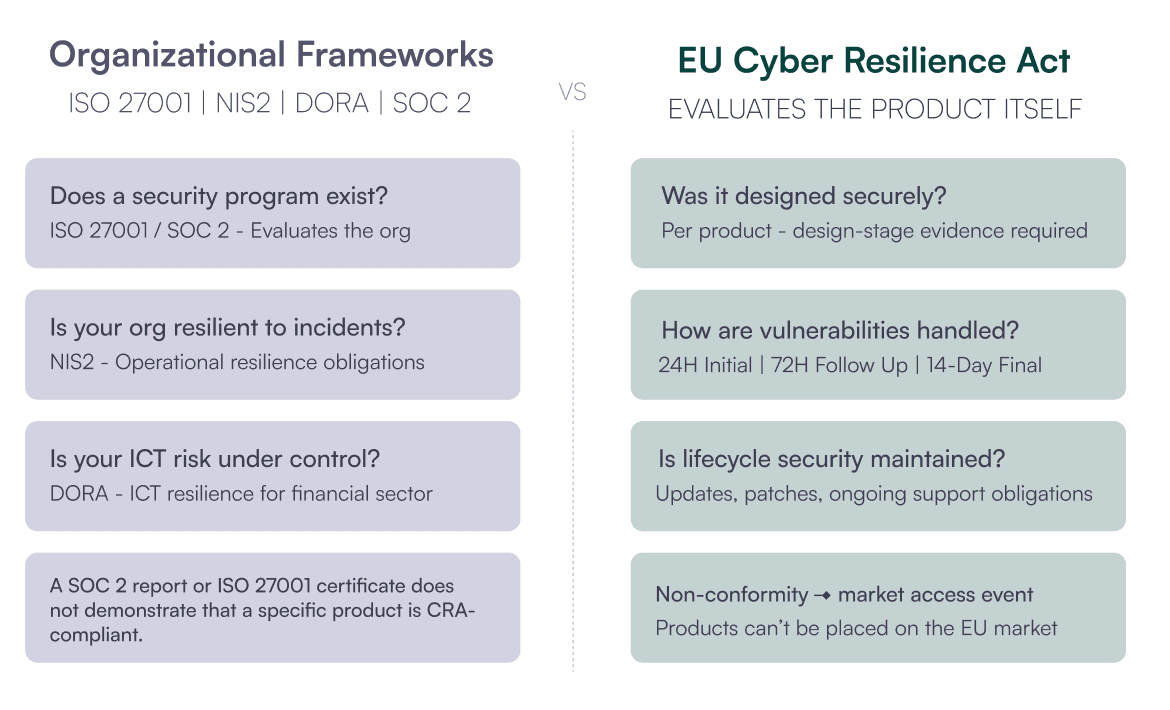
An ISO 27001 certification or SOC 2 report may demonstrate that a security program exists. Conformity under the CRA is a per-product obligation.
This is why many organizations may overestimate their readiness. The CRA does not ask only whether security processes exist. It asks whether a specific product can be examined and defended.
The regulation is broader than design-stage security alone. It brings obligations around vulnerability handling, lifecycle maintenance, technical documentation, reporting, and, in some cases, formal conformity assessment. But for many software organizations, the weakness will surface first in design review: whether product decisions were reviewed early enough, documented clearly enough, and preserved in a form that holds up later.
That is what makes the regulation structurally different. It asks whether the product, and the way it is built and maintained, can withstand examination.
What the CRA Actually Requires
Scope: Products With Digital Elements
The CRA applies to products with digital elements—broadly, software or hardware products and certain components placed on the EU market.
For software organizations, the highest-risk misunderstanding is assuming that a cloud-delivered product is automatically out of scope. A core SaaS platform may sit outside the most obvious interpretation, but downloadable and distributed elements can still create CRA exposure: browser extensions, local agents, installable clients, CLI tools, embedded software, SDKs, and software components integrated into downstream products. This is where many modern software companies are more exposed than they initially assume.
For product and engineering teams, the practical implication is straightforward: scope should not be inferred from product category alone. It needs to be assessed based on how software is packaged, distributed, executed, and maintained.
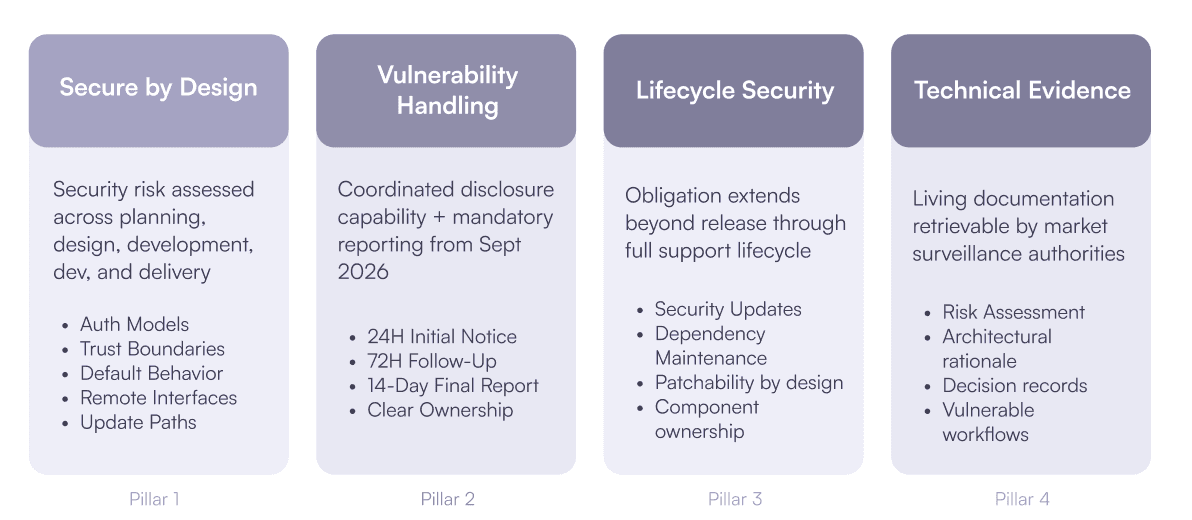
The Four Operational Pillars
The CRA is broad, but its operational impact tends to concentrate in four areas: secure design, vulnerability handling, lifecycle maintenance, and technical documentation.
Why Most Teams Are Not Operationally Ready
CRA readiness breaks when product decisions are made without a durable record of their security implications. By the time the product security team gets involved, the architecture is often already taking shape — and that is exactly where CRA scrutiny begins: what was considered before those decisions were implemented?
The Evidence Readiness Test
A useful way to test readiness is to provide design-phase security evidence for the last twelve features shipped by a product team.
What exists: a feature spec in Confluence, a threat model created for a larger initiative, a few Jira comments, and perhaps a penetration test report covering the current release. What is much harder to produce is a reliable record of what security decisions were made at design time, why they were made, and what risks were identified before implementation began, not reconstructed from project management artifacts after the fact.
That is the gap.
SAST, DAST, SCA, and pentesting can all demonstrate that code or running systems were assessed after they existed. They do not demonstrate that security was considered while the product was still being defined or any risk-based decisions that were made. By the time those tools run, the architecture is already committed. Trust boundaries are established, authentication flows are implemented, and the cost of changing direction is significantly higher.
From a CRA perspective, a scanner output is evidence of technical validation not of design-stage security reasoning.
The Market Surveillance Request
A second failure mode is less about review coverage and more about recoverability.
Imagine being asked to produce the technical security rationale behind a shipped product or feature months after release. In many organizations, that context exists only in scattered form: a design review discussion in Slack, a decision made during sprint planning, a comment on a pull request, or the memory of the engineer who originally built the feature.
The CRA raises the standard for what needs to be retrievable. The documentation it implies is not something that can be assembled credibly after the fact from partial artifacts and institutional memory. It is a record of decisions made during development. If that record was not created during development, it cannot be authentically produced afterward.
The Common Failure Pattern
Both scenarios point to the same weakness: security review often happens after the important decisions are already in place, and the record of that review is too inconsistent to rely on later.
That is not a new problem. Teams have been trying to shift security earlier for years. What the CRA changes is the consequence of not doing so.
Penalties for non-compliance with core obligations such as security by design requirements, vulnerability handling, and lifecycle responsibilities can reach up to €15 million or 2.5% of global annual turnover, depending on the nature of the infringement, with additional penalties for documentation failures, non-cooperation, and inaccurate disclosure. Reporting obligations begin in 2026, with full applicability following in 2027.
This raises the standard for what “ready” means. Earlier review, documentation, and traceability are no longer “good practice.” They are part of whether a product can withstand scrutiny.
The practical challenge is to ensure that product security decisions are made early enough, captured clearly enough, and recoverable when accountability depends on them.
What CRA Readiness Looks Like in Practice
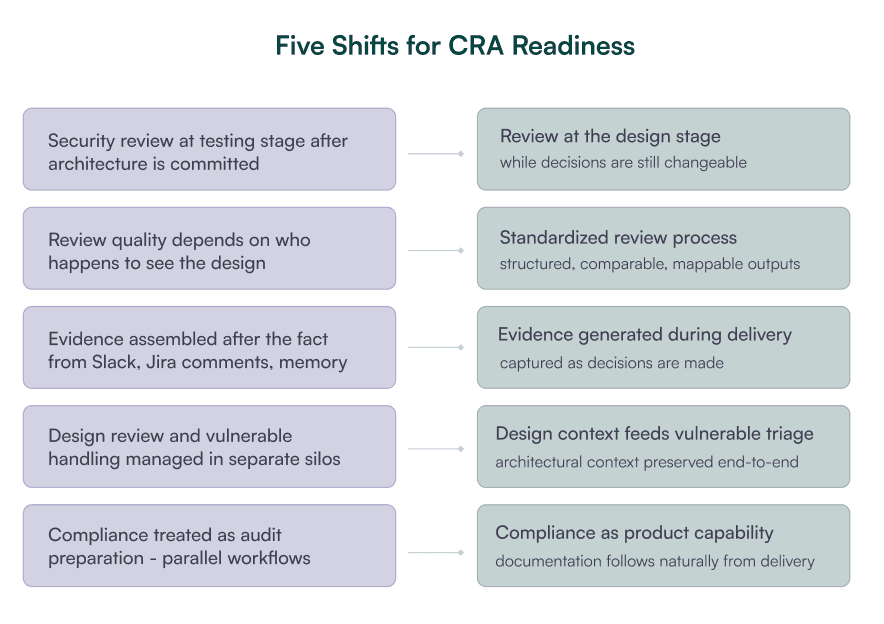
CRA readiness is about making product security review operationally reliable. That requires changes in how teams review design decisions, how they document them, and how security context carries forward through the product lifecycle.
Shift Security Review to the Design Phase
The first requirement is also the most obvious: security review has to happen while the design is still changeable.
The questions that matter most under the CRA are design questions. What data does this feature access? What systems does it trust? How is authentication handled? Where are the trust boundaries? What new attack surface does it create? What happens if it fails in an unexpected way?
These questions have the most value when asked at the architecture and specification stage. After implementation, they have committed answers — answers that may be expensive or architecturally disruptive to change.
This is where many organizations still have no reliable checkpoint or ability to scale even if a checkpoint does exist. Security may be involved eventually, but often not at the point where it can influence the feature with minimal cost.
This is a workflow question. Most existing development processes have no defined and scalable checkpoint where these questions are asked systematically, by someone with security accountability, before implementation begins.
Standardize the Review Process
A review process that depends on the reviewer is not a scalable control.
In many organizations, the quality of security review still depends on whether the right person happened to see the design. A feature reviewed by an experienced AppSec engineer may receive thoughtful scrutiny. A similar feature, reviewed later or by someone else, may receive far less.
It creates uneven coverage, uneven documentation, and inconsistent outputs that are difficult to compare across products or release cycles.
CRA demands structured, comparable, and mappable outputs. Standardization is what closes that gap. It makes review outputs usable across time, teams, and products, and reduces dependency on the availability and expertise of individual reviewers, which is the primary scaling constraint in most product security programs today.
Generate Evidence During Delivery, Not After
One of the biggest shifts the CRA introduces is procedural: evidence needs to be produced as part of the delivery process itself.
That means design risks, accepted mitigations, and open issues should be captured in the development workflow.
This is where many product security workflows break down. Security guidance may be given, but it is often not captured in a form that survives the sprint. Or it is stored in a separate artifact that quickly drifts away from the engineering context it was meant to inform.
A more durable model treats design-stage security output the way engineering already treats code and tickets: as something traceable, attributable, and recoverable.
Connect Design Review to Vulnerability Lifecycle Management
The CRA does not treat secure development and vulnerability handling as separate concerns. Neither should product security teams.
The same architectural context that helps identify risk during design is often what determines whether a vulnerability later discovered in production is severe, exploitable, reportable, or difficult to remediate. If design review and vulnerability handling are managed in separate silos, that context gets lost.
Organizations that are operationally ready will not run design review as a standalone exercise. They will use it to improve how vulnerabilities are triaged, understood, and acted on later in the lifecycle.
Treat Compliance as a Product Capability, Not an Audit Preparation Activity
Organizations that will handle the CRA best are the ones building a delivery model in which security decisions are made earlier, recorded more clearly, and carried forward more reliably.
If CRA readiness is treated as an audit-preparation exercise, teams will create parallel workflows built to satisfy assessment. Those workflows tend to add overhead and decay quickly.
Treated instead as an engineering discipline, CRA embeds security decision-making into how products are built and shipped with documentation emerging as a byproduct of the work itself.
Seen this way, CRA is not just a compliance burden. It is an opportunity to improve product risk management and bring secure products to market more effectively.
Closing the Gap: From Operational Failure to Compliant Workflow
The readiness gap becomes easier to solve once it is framed correctly: parts of the process that matter most under the CRA are manual, inconsistent, and detached from the way product teams actually ship.
That is where automation becomes useful, a way to make design-stage review more systematic and evidence-producing.
Failure Mode 1 — No Design-Phase Evidence
The first failure mode is simple: security review happens too late to produce meaningful design-stage evidence.
Once code exists, the architecture is largely committed. Trust boundaries, authentication patterns, integration points, and data flows are already taking shape in implementation. At that stage, security review can still find issues, but it is no longer operating at the point where product decisions are easiest to influence. Revisiting them is costly at best, architecturally disruptive at worst.
Closing this gap requires review to happen at the specification stage. That means working from the documents product and engineering teams already use to define work: feature specs, PRDs, architecture notes, and planning artifacts while the design is still malleable.
Seezo is built specifically for this operating model.
Seezo ingests documents wherever they already live and reviews them before implementation begins, identifying components, data flows and trust boundaries, generating security requirements and modeling the threats, threat actors and attack paths the design exposes. Every finding is tied to the design input that triggered it.
The result is design-stage evidence with traceable reasoning, produced while the relevant decisions are still being made.
Failure Mode 2 — Security Context Lost and Unreconstructable
The second failure mode is persistence.
Even when security review does happen early, the context often does not survive the workflow. Findings live in a slide deck, comments are buried in chat, and rationale gets lost once the sprint moves on. By the time anyone needs to revisit the decision, the reasoning has degraded or disappeared.
When documentation is requested by a market surveillance authority, what exists is an incomplete record that must be reconstructed expensively and imperfectly.
Closing this gap requires security output to live where product work already lives. Every requirement must be traceable to the exact part of the design document that triggered it.
Seezo delivers findings into tools such as Jira, Slack, and Google Docs so that security context remains attached to the feature and its development record, rather than being isolated in a separate artifact. Each finding remains traceable to the underlying design input, making it easier to understand not only what was flagged, but why.
That traceability is what turns review output into something operationally useful later: engineering follow-through, internal review, or external scrutiny.
90-Day CRA Readiness Plan
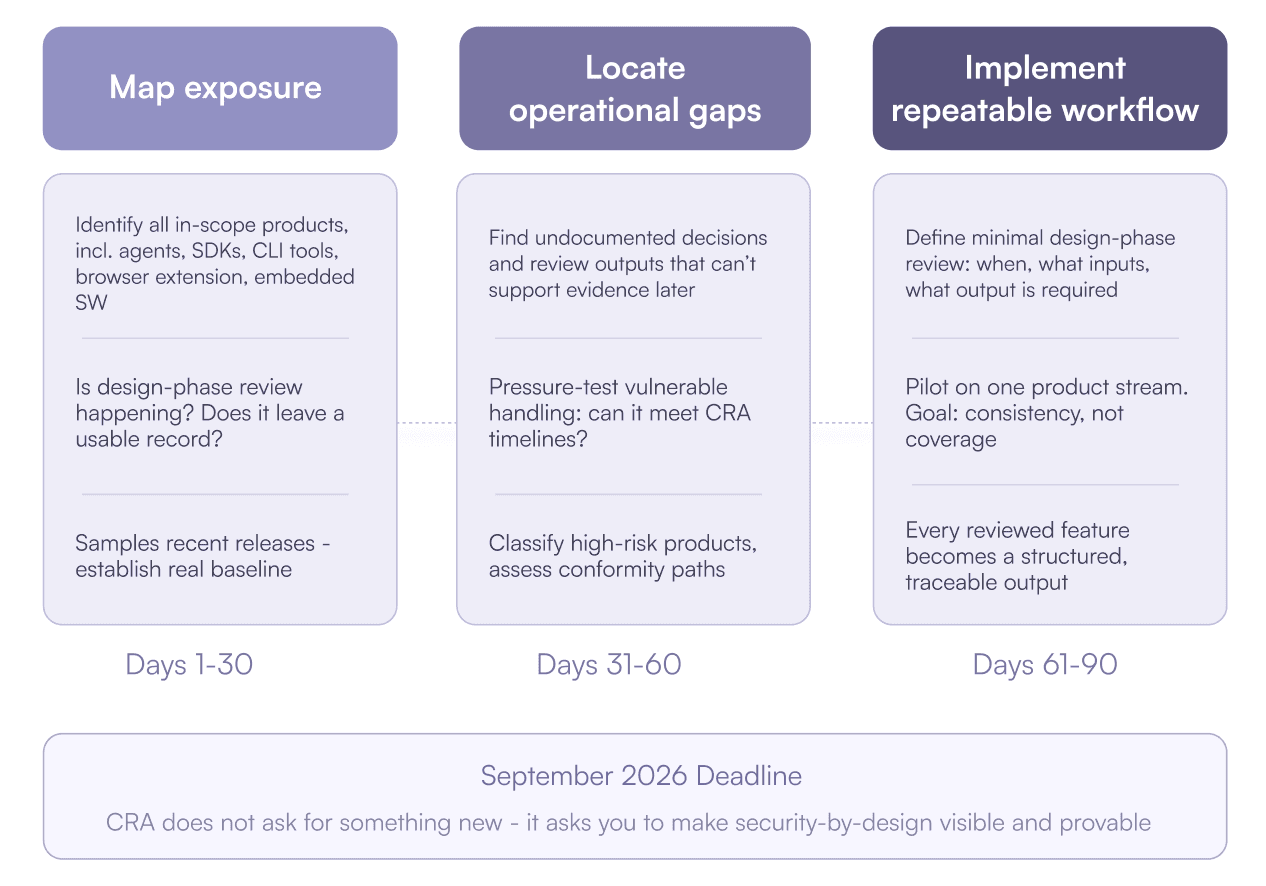
CRA readiness begins with understanding where product security decisions are being made today, how consistently they are being reviewed, and whether those decisions leave behind usable evidence.
Days 1–30: Map Exposure
Identify all products and distributed components that could fall within CRA scope, including agents, SDKs, browser extensions, installable clients, and other client-side or embedded elements.
For each, determine whether design-phase security review is happening and whether it leaves any usable record. At the same time, sample recent releases and check how many shipped features can be tied back to a clear design-stage security decision record. This establishes the real baseline.
Owner: Product security + product / engineering leads
Output: A clear inventory of in-scope products and a baseline view of where design-stage security decisions are currently being captured
Exit criteria:
In-scope products and components are identified
Existing design-review coverage is visible
Gaps in security decision capture are understood
Days 31–60: Locate Operational Gaps
Identify where security decisions are being made without documentation and where review output cannot support product-level evidence later.
Pressure-test whether vulnerability handling can support CRA-style reporting obligations in practice. Review whether disclosure intake, triage, escalation, and reporting workflows are defined well enough to operate within the required timelines.
In parallel, identify products likely to fall into higher-risk CRA categories and assess whether additional conformity or external assessment paths may apply. This is where many teams discover that product classification, ownership, and evidence are less clear than assumed.
Owner: Product security + incident response / PSIRT + compliance / legal stakeholders
Output: Clear view of the main operational gaps across evidence, reporting, and product classification
Exit criteria:
Documentation and evidence gaps are clearly identified
Reporting workflows have been tested against CRA expectations
Higher-risk products have been flagged for additional assessment needs
Days 61–90: Implement a Repeatable Workflow
Define a minimal design-phase review workflow that specifies when review happens, what inputs are required, and what output must be produced.
Pilot that workflow on one product or feature stream. The goal is not broad coverage yet. It is consistency. Every reviewed feature should produce structured, traceable output.
From there, identify what would be required to scale—where automation is needed, where bottlenecks exist, and how review can fit into existing engineering workflows without slowing delivery.
Owner: Product security + engineering leadership
Output: Working review workflow and a pilot set of real, traceable security decision records
Exit criteria:
The workflow is being used consistently
Reviewed work produces structured, traceable records
The team understands what is needed to scale
Conclusion
The EU Cyber Resilience Act changes how product security is evaluated. It shifts the focus from how organizations manage security to demonstration that security was considered throughout product design and lifecycle.
The organizations that meet this standard will not be the ones that spend the months before September 2026 assembling documentation. They will be the ones that build delivery workflows in which security decisions are made at design time, recorded as development artifacts, and retrievable when accountability is required.
CRA turns security by design from a principle into a demonstrable requirement. September 2026 is the near-term deadline.
CRA does not ask organizations to do something new. It asks them to make visible and provable what security by design has always required.
Seezo is built for exactly this operating model: embedding security design reviews and threat modeling at the specification phase, generating structured, traceable evidence to support CRA conformity assessments, and delivering contextual, explainable findings directly into the workflows engineering teams already use. Seezo carries those security requirements into the AI-SDLC, where its AI Plugin validates that the code remains faithful to the approved design.
About Seezo
Seezo automates security design reviews and threat modeling for every feature your team builds. It ingests the documentation teams already produce: design docs and PRDs, architecture diagrams and DFDs, Markdown files, and tickets in Jira or ServiceNow, wherever they live across Confluence, Google Docs, Slack, or Teams. It analyzes this context and produces:
Security Design Review: Identifies components, data flows, and trust boundaries, then generates security requirements, open questions, and a data flow diagram, with findings that are contextual, explainable, and traceable.
Threat Model: Identifies relevant threats, threat actors, and attack paths, recommends mitigations to address each threat.
Requirements are delivered directly into developer workflows before development begins. And where features are built by coding agents, Seezo's AI Plugin feeds that security context to the agent as it works and validates that the implementation honors the design: carrying the same requirements through the AI-SDLC.
Seezo's architecture employs structured rule decomposition with 1000+ researcher-written rules organized in decision-tree workflows, providing explainability, consistency, and auditability. It maps findings to compliance standards including PCI DSS, ASVS, HIPAA, and SOC 2, supports custom rules aligned to your organization's risk profile, and is available as SaaS or self-hosted on AWS and Azure.
Have questions or want to learn more about how Seezo can help your team? Reach out to us directly: hi@seezo.io
Frequently asked questions
How is the Cyber Resilience Act different from existing cybersecurity regulations?
Unlike many cybersecurity frameworks that focus on organizational security practices, the Cyber Resilience Act places legal obligations on the security of individual products with digital elements. Organizations must demonstrate that security has been considered throughout the product lifecycle, maintain evidence of secure development decisions, and establish ongoing vulnerability management after release.
When does CRA actually take effect?
The Cyber Resilience Act becomes fully applicable on 11 December 2027, with key obligations around vulnerability reporting taking effect earlier. Organizations selling products with digital elements into the EU should begin preparing well before the enforcement date, as establishing secure development practices, evidence collection, and vulnerability management takes time.
Is my product in scope?
The Cyber Resilience Act applies to most products with digital elements that are placed on the EU market, including software, connected devices, browser extensions, local agents, SDKs, and embedded systems. If your product contains software and is sold or distributed in the EU, you should assess whether it falls within the CRA’s scope and applicable product class.
What does the Cyber Resilience Act require for vulnerability handling?
The CRA requires organizations to establish a repeatable vulnerability management process covering vulnerability reporting, coordinated disclosure, remediation, and communication with customers and authorities within defined timeframes. Treating vulnerability handling as an informal or ad hoc activity makes it difficult to demonstrate compliance during audits.
How much time do organizations need to prepare for CRA?
Organizations can usually establish baseline readiness within the first few months by identifying products in scope, assessing current development practices, documenting compliance gaps, and defining repeatable workflows. Achieving full compliance typically requires a longer-term program that includes secure-by-design processes, vulnerability management, evidence collection, and cross-functional governance.