Back to Whitepapers
Cross-Industry
Secure Design Reviews
Reimagining Secure Design Review in the Age of AI
BSIMM16 shows 80%+ of AppSec teams now do security design reviews. See why manual reviews can't scale, and how to weigh AI build-vs-buy for automation.
By: Team Seezo
Executive Summary
In January 2026, the Building Security In Maturity Model released its sixteenth edition, BSIMM16. Of the 111 organizations it tracked, over 80% now conduct security design reviews, placing the practice alongside incident response as a near-universal expectation in mature application security programs.
Yet the very development trends driving this adoption: faster release cycles, microservice architectures, and AI-assisted code generation are making manual security design reviews harder to scale. Meanwhile, most AppSec teams are staffed at two to three engineers per hundred developers. As engineers ship more code ever faster, the math stacks up against AppSec teams. Manual reviews simply cannot keep pace. AI offers a way forward, but it also introduces new risks. A AI-powered review tools carry their own failure modes that organizations cannot afford to ignore.
This white paper examines both sides of the equation. It explores how AI reshapes the threat landscape that makes design review critical, and how AI-powered automation can scale these reviews without sacrificing quality.
But AI also presents organizations with a challenging new question: do you build such tooling internally, or adopt a purpose-built platform?
Drawing on the work we do at Seezo, this whitepaper offers an analytical framework that AppSec leaders can use to make an informed build- versus-buy decision.
Why Security Design Review, why now
Application security has traditionally focused on finding bugs after code is written. Tools such as static analysis, dynamic testing, and dependency scanning analyze implementation artifacts. While valuable, they share a fundamental limitation: they can only detect issues that already exist in code.
Security design review operates earlier in the lifecycle. It evaluates architectural decisions, authentication flows, data handling patterns, trust boundaries, and third-party integrations before implementation begins. When these design choices are flawed, downstream tools detect symptoms rather than root causes. Fixing an insecure authentication architecture in production can require coordinated changes across multiple services, making remediation far more costly than addressing the issue during design. That economic argument has always been true. Two forces make it urgent in 2026.
Where Security Design Reviews Fit in the SDLC

Figure 1: Security design review operates at the design phase, upstream of traditional AppSec tools.
Regulatory Pressure
The first pressure is regulatory. Regulators now require evidence that security was considered at the design stage not merely tested after deployment.The deadlines are imminent and the penalties are real.
The EU Cyber Resilience Act mandates secure design for all products with digital elements, with a 2027 deadline and fines up to €15 million or 2.5% of global turnover. In the US, Executive Order 14028 ties federal procurement to the NIST SSDF, which explicitly requires threat modeling during development. Organizations that cannot self-attest to these practices under OMB M-22-18 risk losing government contracts. CISA's Secure by Design initiative, backed by joint guidance from eight countries, is shifting market expectations industry-wide.
Sector-specific mandates follow the same pattern. FDA Section 524B now requires threat models and security architecture controls in all premarket submissions for connected medical devices and can refuse submissions that lack them.
In financial services, PCI DSS 4.0 strengthens security-by-design requirements, while the EU's DORA regulation and mandates from India's SEBI and Singapore's MAS impose similar obligations. The NIS2 Directive extends mandatory cyber risk management across essential EU entities in healthcare, energy, and digital infrastructure.
Scan results and pen test reports are no longer enough. Regulators want to see which risks were identified at design, which controls were planned, and how they map to specific features.
AI-Generated Code
If the first pressure is outside-in, the second is inside-out. Code generated by large language models often satisfies functional requirements while lacking the security controls that experienced developers would include instinctively. The code compiles, passes basic tests, and looks professional but may omit input validation, fail to enforce authorization checks, or mishandle secrets.
This creates a paradox. Development velocity increases, but the implicit security knowledge that experienced developers carried is no longer reliably embedded in the output. If you cannot fully trust the code being generated, you need stronger assurance at the architectural level. Design review becomes more than a best practice, it becomes a necessary control.
Why Manual Design Reviews Cannot Keep Pace
Despite its importance, security design review remains one of the hardest AppSec activities to scale. The challenge is structural. Design review requires interpreting intent from unstructured artifacts, product requirements, architecture diagrams, Jira tickets, Confluence pages then reasoning about security properties. There's no syntax to parse, no manifest to scan. It requires judgment.
The Coverage Gap: Manual vs. Automated Review
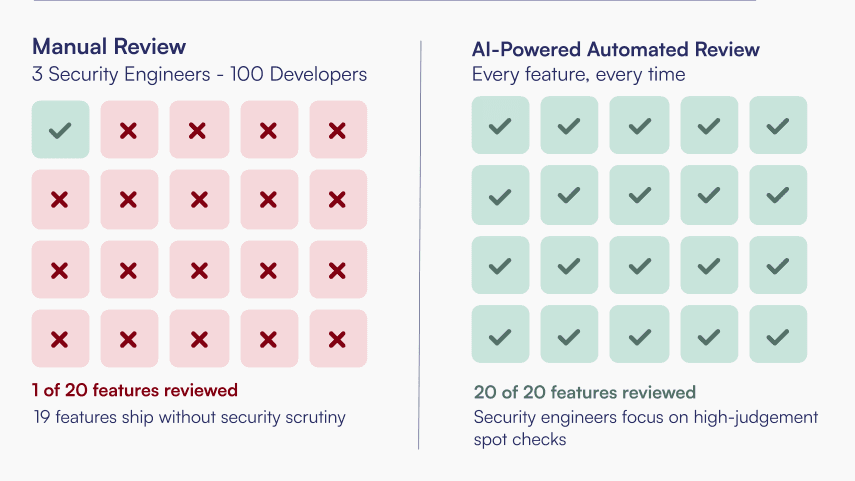
That judgment demands senior AppSec engineers. At two to three per hundred developers, teams can't review everything, so they face an impossible prioritization problem and review the crown jewels. BSIMM's maturity model reflects this ceiling. Most organizations plateau at Level 1 or 2, basic checks, some repeatable processes. Level 3, where engineering teams lead their own analysis
Few organizations reach Level 3 precisely because it requires a degree of automation and workflow integration that manual processes cannot provide.

The Promise and Peril of AI- Powered Design Review
For the first time, in early 2026, it is possible to automate meaningful aspects of security design review. State-of-the-art LLMs can parse unstructured documents, identify architectural components, reason about trust boundaries, and generate security requirements. The unstructured nature of design artifacts was the primary barrier to automation for over a decade. LLMs finally change that.
What AI Does Well
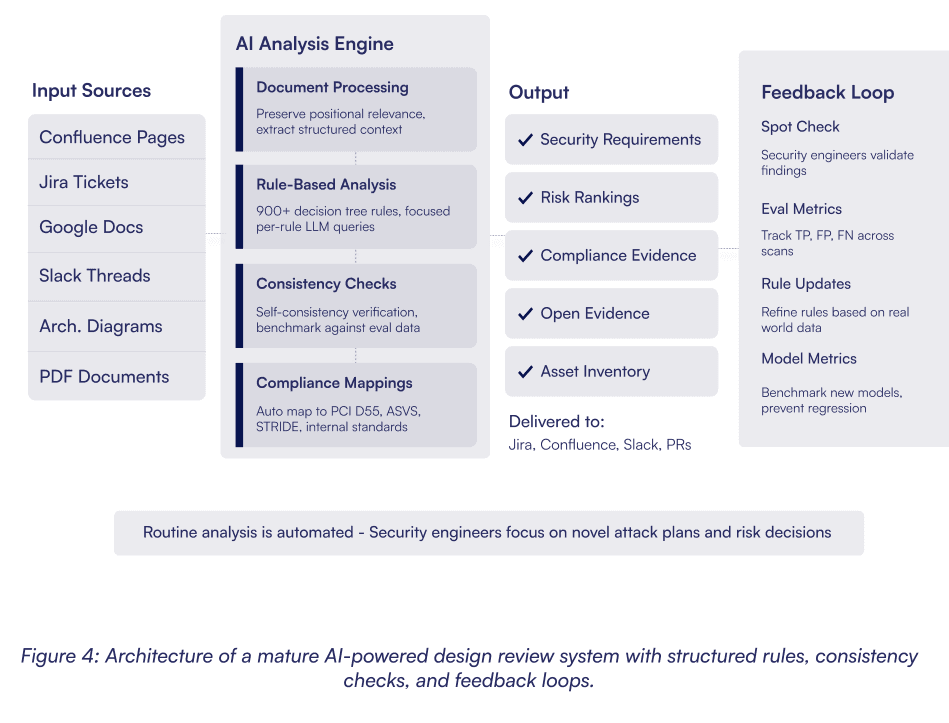
Processing unstructured input at scale: AI can ingest Confluence pages, Google Docs, PDF documents, diagrams, Jira tickets, and Slack threads extracting architectural context from the messy reality of how teams actually document their designs. This alone removes one of the biggest bottlenecks in traditional design review: the requirement for a human expert to manually read and interpret every document.
Consistent application of known rules: Given a well-defined security rule
˝Is data encrypted at rest?˛ or ˝Are authorization checks enforced at the API gateway?˛an AI system can apply it consistently across hundreds of design documents. A human reviewerˇs att s attention drifts after the tenth document. A well-designed AI system does not.
Mapping to compliance frameworks: AI can automatically map identified security requirements to specific standards such as PCI DSS, ASVS, or STRIDE. This changes compliance from a separate, retrospective exercise into a direct output of the design process.
What AI Makes Dangerous
But for all its promise, AI-powered design review carries its own failure modes. Building Seezo has meant confronting these challenges directly; each one discovered not in theory, but in the course of engineering a system that our customers rely on daily. The following risks are real, and addressing them has shaped much of how Seezo's platform works today.
The black box problem: A single, monolithic prompt asking an LLM to
˝review this design for security issues˛ p produces an opaque process. You cannot see which rules the model prioritized, which it ignored, or why it reached a particular conclusion. In security and legal compliance, this level of opacity is disqualifying. If you cannot explain how a security decision was made, product teams, regulators and auditors will not accept it.
Consistency and determinism: Large language models are inherently non-deterministic. The same input can produce different outputs across runs. This is acceptable for creative writing; it is unacceptable for security assurance. If two engineers scan the same design document on the same day and receive different security requirements, trust in the system erodes immediately.
Knowledge staleness: LLMs have training data cutoffs. A model trained through January 2025 has no knowledge of protocols, services, or vulnerability classes introduced afterward. In a field where the attack surface evolves continuously with new cloud services, API patterns, and regulatory requirements, systems that rely solely on model training data will inevitably drift out of date.
Hallucination and false confidence: Modern models hallucinate less than earlier systems, but the problem has not disappeared. Instead, it has become subtler and harder to detect. Rather than fabricating information outright, models now apply recommendations that are technically valid but contextually wrong, or miss genuine risks because the prompt didn't draw sufficient attention to them.
The Build vs. Buy Decision
When organizations recognize the need for AI-powered design review, many instinctively reach for a build-it-ourselves approach. The reasoning is understandable: the team has access to LLM APIs, security domain expertise, and engineering resources. Building in-house promises full control and customization. But it also involves the total cost of building, maintaining, and improving a production-grade system.
Neither path is obviously correct. The right answer depends on organizational scale, risk tolerance, data residency obligations, and how the security engineering team's capacity is best deployed. This section examines the honest costs and tradeoffs on both sides.
Initial Development
A proof-of-concept is straightforward. An engineer can connect an LLM API, write a prompt, pass in a design document, and get a list of security findings. This can be accomplished in days.
The distance between this prototype and a production system, however, is vast. A production-grade tool requires robust document processing that preserves positional relevance across PDFs, diagrams, and mixed- content pages. It needs a structured rule framework, potentially hundreds of specialized prompts organized in decision-tree architectures that constrain the LLMˇs s behavior and improve consistency. It demands integration with the tools teams already use: Jira, Confluence, Google Docs, Slack, and ticketing systems. And it needs an evaluation framework to measure accuracy, consistency, and coverage across diverse document types.
Conservatively, this initial build requires four to six months of dedicated engineering time from a team that combines senior AppSec expertise with AI/ML engineering capability.
Ongoing Maintenance
The initial build is only the beginning. Several ongoing costs are frequently overlooked:
Rule maintenance and knowledge updates: Security standards evolve. PCI DSS releases new versions. New vulnerability classes emerge. Cloud providers introduce new services with new security considerations. Someone must continuously update the rule set, test changes against existing documents, and validate that updates do not introduce regressions. This is effectively a full-time security research function.
Model management: LLM providers update and deprecate models on their own schedules. A system built on a specific model version may require significant prompt re-engineering when the provider upgrades. Organizations must continuously evaluate whether newer models improve or degrade output quality and maintain the evaluation infrastructure to measure that difference objectively.
Consistency engineering: Achieving reliable, reproducible results from probabilistic AI systems is an ongoing discipline. It requires techniques such as self-consistency checking (running the same prompt multiple times and reconciling outputs), granular prompt decomposition, and continuous benchmarking. Without sustained investment, result quality degrades, findings drift, coverage shrinks, and the system becomes less trustworthy without anyone noticing until something is missed.
API and infrastructure costs: Running hundreds of specialized prompts per document through LLM APIs generates substantial token consumption. A dedicated team will optimize caching, manage token budgets, and engineer cost-efficient pipelines. An internal team without this as a primary focus will typically burn through significantly more API spend for equivalent output.
Opportunity Cost
The most significant cost of building internally is what the team does not build instead. Every engineering cycle spent maintaining an AI security review tool is a cycle not spent on other security improvements: hardening CI/CD pipelines, improving incident response, extending vulnerability management, or acting on the findings the reviews themselves produce.
Build vs. Buy: Total Cost of Ownership
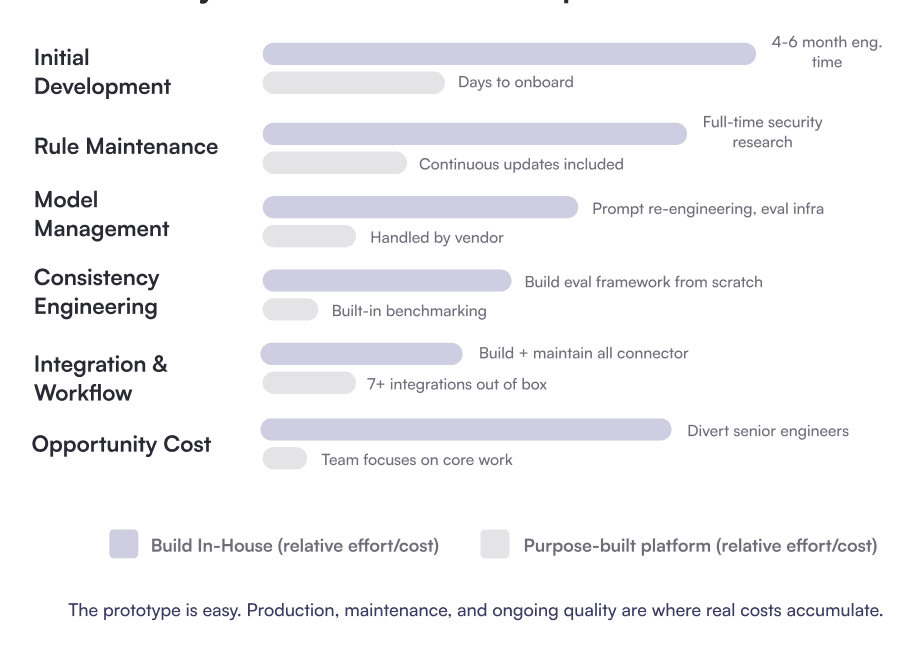
For organizations with large, well-resourced security engineering teams, building in-house may make strategic sense, particularly if the tool addresses a unique internal workflow that no external platform supports. For most, the calculus favors a purpose-built platform and redirecting engineering capacity toward evaluating novel attack paths, making risk- acceptance decisions, and the judgment-intensive work automation cannot replace.
What a Mature AI-Powered Design Review System Looks Like
The previous sections outline what it takes to build an AI-powered security design review system. But what does a production-quality, world-class system look like once you move past the MVP stage? At Seezo, we have found that the following characteristics separate a system that works in a demo from one that organizations can rely on every day.
Structured Rule Decomposition
Rather than a single monolithic prompt, mature systems decompose security analysis into hundreds of discrete, focused rules. Each rule addresses a specific question: Is encryption at rest configured for this data store? Are authorization checks enforced at the API boundary? Does this integration validate certificates?
This decomposition constrains the model's decision-making scope, improving accuracy and consistency. It makes the system auditable: every finding traces back to the specific rule that produced it. And it makes the system modular: rules can be added, updated, or removed without cascading effects across the entire analysis.
Component-Level Analysis
Treating a design document as a single unit, where the entire document is input and a unified set of security requirements is output, can fall short when the document describes multiple services, databases, and APIs. The question "is the database encrypted?" might have three different answers depending on which database you mean.
A mature system decomposes the design document into its constituent parts: components, assets, and data flows before running any security analysis. Each requirement then traces back to a specific component, not just the document as a whole. This specificity is what makes findings actionable rather than generic.
Explainability and Auditability
In security and compliance, explainability is not optional. A mature system shows how it arrived at each finding: which rules were triggered, what evidence in the design document supported the conclusion, and why a specific security requirement applies to a specific feature.This transparency is essential for auditors, for security engineers performing spot checks, and for developers who need to understand why a particular security requirement applies to their feature.
Continuous Evaluation
Production-grade systems track true positives, false positives, and false negatives across synthetic and real-world documents. When a new rule is added or a model is updated, the evaluation framework automatically measures the impact on accuracy and consistency. T This is what prevents silent quality degradation: the failure mode where the system keeps producing output while quietly becoming less accurate.
Developer Workflow Integration
The most technically accurate security review system is useless if developers do not engage with its output. Leading implementations deliver security requirements directly into the tools developers already use: Jira tickets, Confluence comments, Slack messages, and pull request annotations. Developers should not need to log into a separate platform, file a request, or wait for a review cycle. Security requirements should arrive alongside functional requirements, as a natural part of the design conversation.
Evaluating Your Options: A Framework
Given everything outlined above, organizations considering AI-powered security design review should evaluate their options across several dimensions:
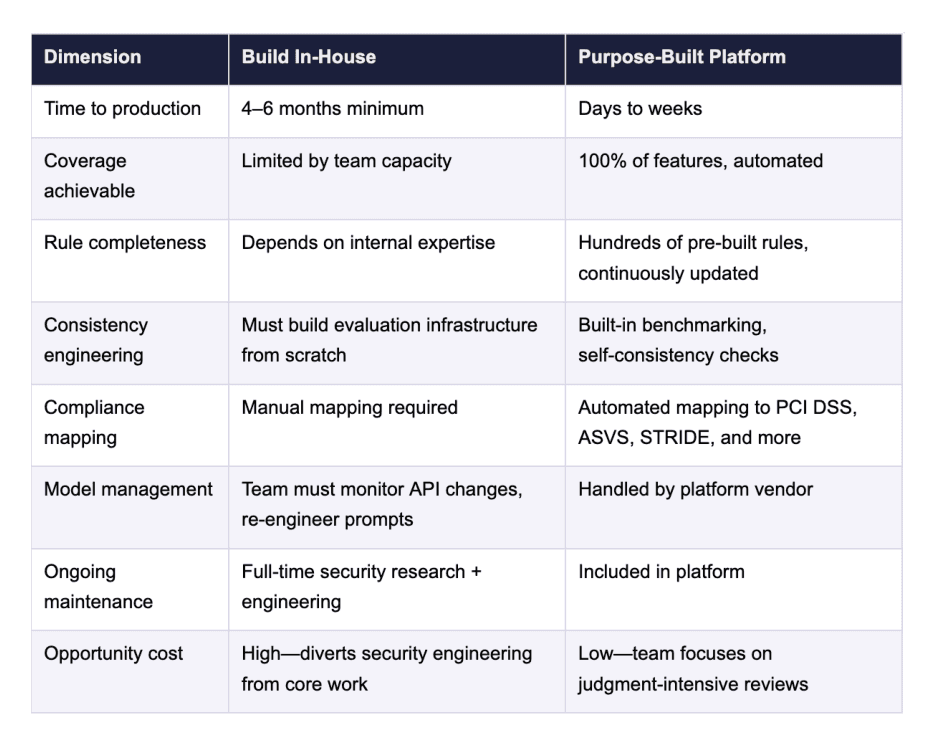
The Path Forward
AI-generated code is amplifying the need for upstream security controls. The organizations that will lead in application security over the next several years are those that make design review systematic, scalable, and continuous, not episodic, manual, and limited to the crown jewels.
AI makes this possible. But realizing the promise requires more than connecting an LLM to a design document. It requires structured rule decomposition, consistency engineering, continuous evaluation, and deep integration into developer workflows. It requires ongoing investment in knowledge completeness and model management.
Speed without accuracy is just faster noise.
For most organizations, the most effective path is to adopt a platform purpose-built for this problem and direct their security engineering capacity toward the judgment-intensive work that only humans can do: evaluating novel attack paths, making risk-acceptance decisions, and mentoring development teams on secure design principles.
About Seezo
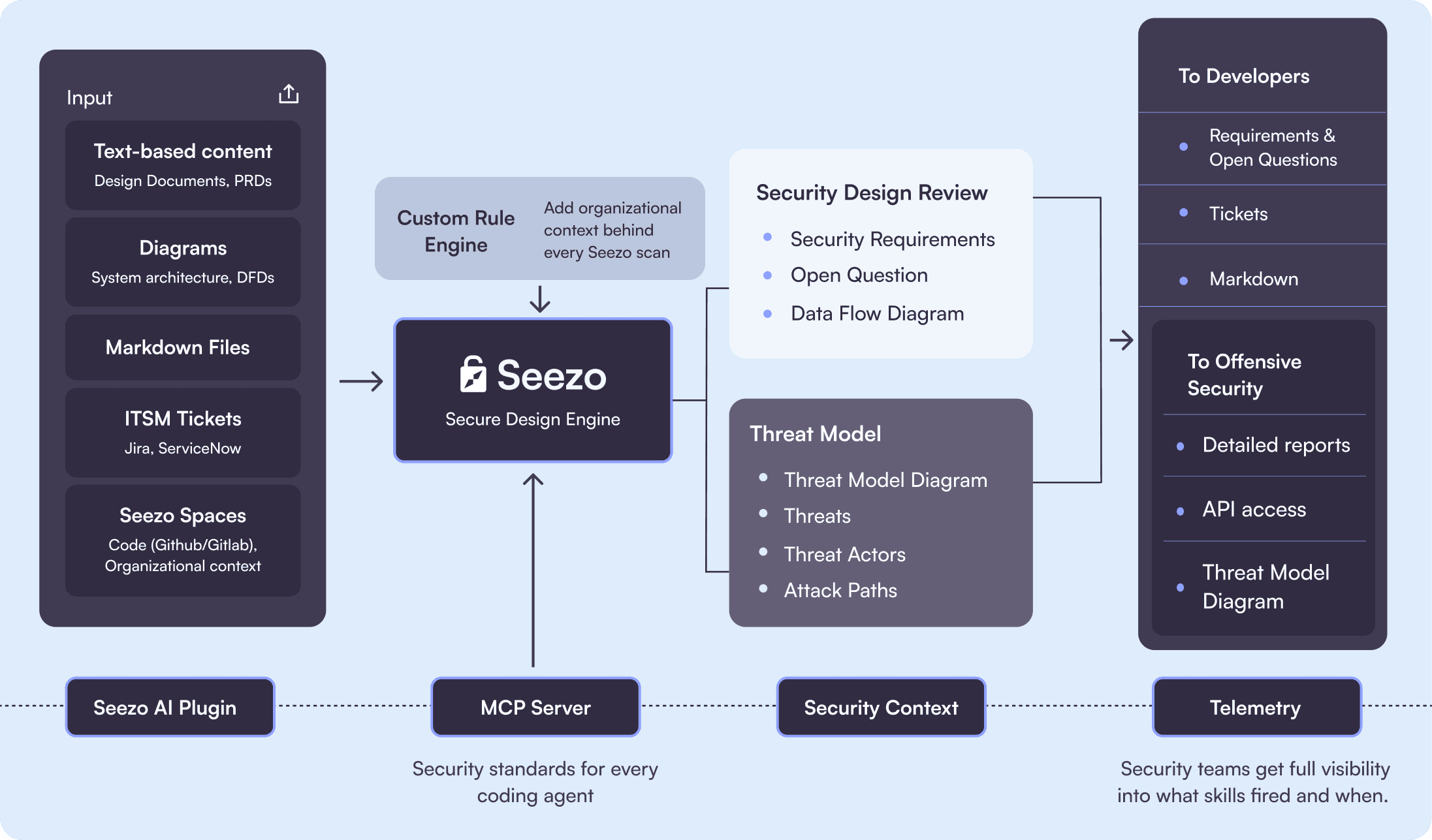
Seezo automates security design reviews and threat modeling for every feature your team builds. It ingests the documentation teams already produce: design docs and PRDs, architecture diagrams and DFDs, Markdown files, and tickets in Jira or ServiceNow, wherever they live across Confluence, Google Docs, Slack, or Teams. It analyzes this context and produces:
Security Design Review: Identifies components, data flows, and trust boundaries, then generates security requirements, open questions, and a data flow diagram, with findings that are contextual, explainable, and traceable.
Threat Model: Identifies relevant threats, threat actors, and attack paths, recommends mitigations to address each threat.
Requirements are delivered directly into developer workflows before development begins. And where features are built by coding agents, Seezo's AI Plugin feeds that security context to the agent as it works and validates that the implementation honors the design: carrying the same requirements through the AI-SDLC.
Seezo's architecture employs structured rule decomposition with 1000+ researcher-written rules organized in decision-tree workflows, providing explainability, consistency, and auditability. It maps findings to compliance standards including PCI DSS, ASVS, HIPAA, and SOC 2, supports custom rules aligned to your organization's risk profile, and is available as SaaS or self-hosted on AWS and Azure.
Book a walkthrough →
Have questions or want to learn more about how Seezo can help your team? Reach out to us directly: hi@seezo.io
Frequently asked questions
Should we build an AI Security Design Review (SDR) system in-house or buy one?For most organizations, buying an AI Security Design Review solution is faster and more cost-effective than building one internally. Building typically requires four to six months of engineering effort, ongoing security research to maintain the rule base, continuous model evaluation, and workflow integrations. Unless AI Security Design Reviews are a strategic differentiator, most AppSec teams get greater value by adopting an established platform.
What does production-grade AI SDR look like?
Production-grade AI Security Design Review systems are designed for consistency, explainability, and continuous improvement—not just accuracy. They decompose reviews into hundreds of specific security rules rather than relying on a single prompt, analyze architectures at the component level, explain every finding, continuously evaluate performance for regressions, and integrate into existing engineering workflows. Together, these make AI reliable enough for enterprise AppSec programs.
Why do Security Design Reviews fail to scale?
Most Security Design Review programs plateau because AppSec teams simply can’t keep pace with engineering growth. Ratios of two to three AppSec engineers per hundred developers mean only the highest-risk features receive manual reviews, while incremental changes often go unreviewed. Without automation, review capacity becomes constrained by available security expertise rather than development velocity.
How do we trust output from an AI reviewer?
AI-generated security findings are trustworthy only when they’re explainable and continuously evaluated. Every finding should be traceable to the security rule that generated it, the evidence in the source design, and the reasoning used to reach the conclusion. Combined with ongoing evaluation against known outcomes, this gives AppSec teams confidence that AI recommendations are consistent, auditable, and defensible.