Back to Whitepapers
Cross-Industry
AI in SDR and TM
The State of AI in AppSec 2026: Proven, Promising, and Emerging
AI in AppSec is moving from pilots to production. See what's actually working, what's overhyped, and how to operationalize AI security tooling in 2026.
By: Team Seezo
Executive Summary
AI is now part of every AppSec conversation, but adoption remains uneven. In 2023 and 2024, most large organizations experimented with pilots or isolated proof-of-concepts. A few succeeded, most stalled.
Teams that built well-defined, narrow use cases have seen measurable results. Productivity tools are now part of every AppSec engineer’s arsenal. Replacing entire workflows with AI has been a struggle in many use cases.
The good news is LLM costs are dropping, context windows are increasing, and reinforcement learning is beginning to show value. That means 2026 will be the year AppSec teams start to actually operationalize AI, and not just experiment with it.
This whitepaper highlights what’s actually working, what’s overhyped, and where real change is likely in the next year. It also offers practical guidance for AppSec teams on planning and putting AI to work effectively in 2026.
The State of AI in AppSec (2025– 2026)
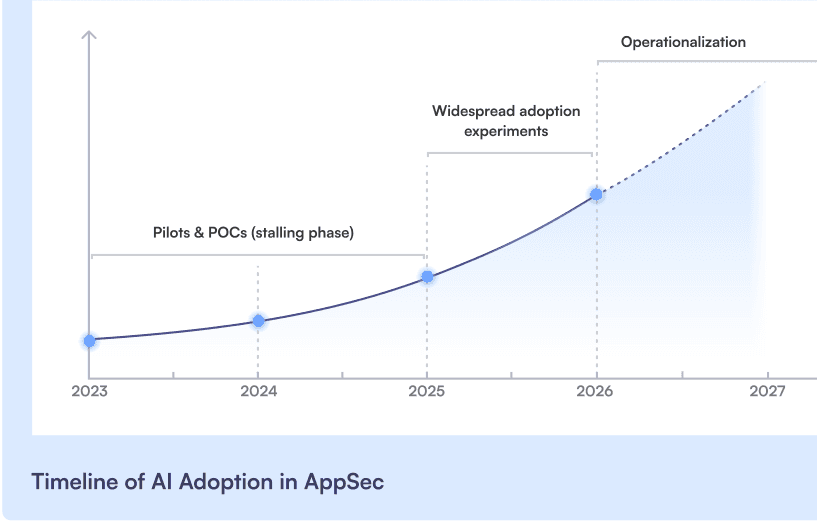
Application Security (AppSec) still depends heavily on manual work. Security engineers spend countless hours reviewing code, performing design reviews, and managing coordination across development, product, and DevOps teams.
AI has the potential to change this. It can automate tedious workflows, surface insights faster, and allow AppSec teams to scale their coverage without increasing headcount.
The shows that adoption is already widespread. 77% of organizations are actively using AI in their workflows, and 81% plan to increase their use over the next year. Confidence is high, with most respondents expressing at least some trust in AI’s capabilities.
Fastly 2025 AppSec survey
At the same time, oversight is limited. A third of respondents say that half or more of AI-identified issues are acted on without human review.
Many proof-of-concepts have failed to move past the experimentation stage. Tools that looked promising in early demos often fell apart in production.
Proven AI Use Cases in AppSec for 2026
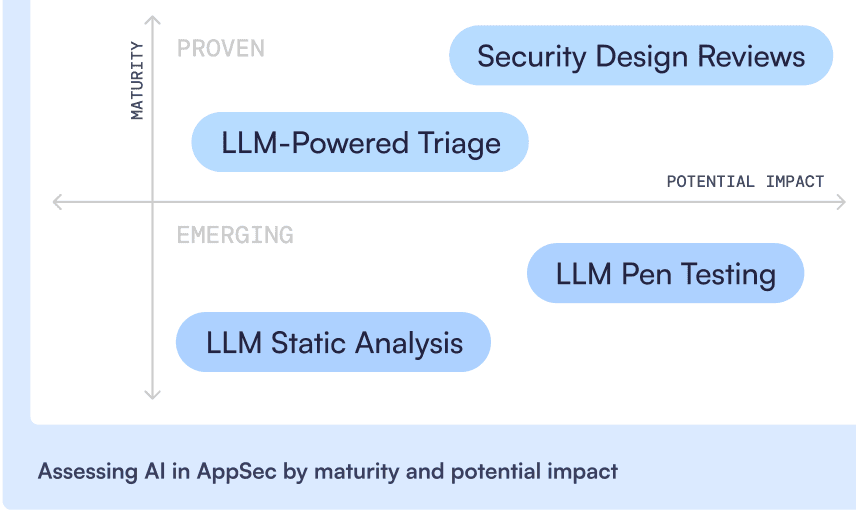
AI is showing real, measurable impact in three AppSec workflows.
1. AI-powered security design reviews
Platforms like Seezo are already helping financial services and healthcare companies scale their Security Design Reviews and Threat Modelling. One financial services client, for example, increased coverage from just 10% of features to 80%, significantly lowering the risk of missing critical security gaps.
These tools augment security architects rather than replace them, allowing teams to analyze more features in less time. AI can also highlight potential architectural risks early, helping teams fix issues before code is written, which is far more cost-effective than post-release remediation.
2. AI-powered triage for SAST and SCA results
AI-powered triage is another strong use case. Modern AppSec programs often produce thousands of findings from static analysis (SAST) and software composition analysis (SCA).
LLMs can analyze scanner output, prioritize true positives, and filter out noise, reducing manual review time.
Companies like Snyk and Semgrep have started integrating AI-based triage directly into their products. It’s not a replacement for scanning, but it’s a clear productivity boost that shortens review cycles.
3. Empowering AppSec engineers with AI tools
AI can make engineers more productive, and in 2026, it’s the easiest way to bring AI into AppSec programs. Chatbots like ChatGPT, Gemini, Claude AI, and code generation tools like Cursor or Claude Code help engineers research vulnerabilities, automate documentation, and write or fix code faster.
When rolling out these tools, there are a few things to keep in mind. AI models should run where your sensitive data lives. If your code or architecture diagrams are inside your network, the models should be too. For example, running Cursor with Claude via AWS Bedrock on your own deployment and keys ensures data privacy and compliance.
AI outputs should support engineers, not replace them. Treat results as suggestions or drafts, and remember that engineers are still responsible for accuracy, completeness, and risk decisions.
Used thoughtfully, they can cut down repetitive work, speed up investigations, and free engineers to focus on higher-value security tasks.
Like AI-powered triage for SAST and SCA, they don’t replace expertise but make teams faster and more effective.
The goal is to enable AppSec teams, not to outsource critical thinking to a model.
Promising but Emerging Areas
AI is moving fast, but not every new tool lives up to the hype. Two areas to watch closely in 2026:
Automated penetration testing
Vendors like Horizon3 and X-Bow are building AI-driven penetration testing systems that mimic manual testers, and even established tools like BurpSuite are starting to add AI capabilities. PortSwigger's research shows how AI can help document and summarize pentest findings more efficiently, making it easier for teams to act on results.
Early benchmarks look promising, but real-world results are still mixed.
Challenges include:
Reproducibility: AI-generated attack paths can vary across runs, making results hard to validate. Contextual Understanding: AI struggles with business-logic vulnerabilities and environment-specific setups that human testers navigate intuitively. Cost: High compute and token requirements make continuous deployment expensive. Integration: Many tools function as black boxes, limiting CI/CD integration and evidence tracking for compliance.
These tools are best used to augment human testers, accelerating reconnaissance and generating hypotheses, while humans handle verification and remediation. Treat this as an area for experimentation, not replacement.
2. LLM-powered static analysis
Challenges include:
Explainability: Findings are often difficult to trace to specific code paths or patterns.
Consistency: Results can vary across runs, complicating CI/CD integration and regression testing.
Scalability: Large codebases require significant compute and can introduce scanning delays.
There are 3 kinds of companies worth watching closely in this space
Code-generation platforms like Claude Code are building their own security review tooling as part of the broader developer workflow.
Established SAST vendors such as Snyk and Semgrep are layering AI intelligence AI capabilities on top of traditional rule-based scanning.
LLM-native security startups like Dryrun and Corgea are rethinking static analysis entirely, using language models to reason about code semantics rather than syntax rules.Consistency, explainability, customization, and compute requirements remain key challenges. Expect major movement in 2026, but these areas should be treated as pilots to support human testing, not replace it. The winning model is not clear yet.
How Not to Use AI in AppSec
AI adoption often stumbles because teams treat it as a black box. Here are three common mistakes and why they matter.
Removing humans from the loop
AI can process large volumes of data quickly, but it lacks organizational context and the reasoning behind a security decision. Relying only on AI findings risks overwhelming developers with false positives and irrelevant alerts, which leads to alert fatigue and disengagement.
Human review provides judgment, prioritization, and trust. AppSec programs succeed when findings are accurate and actionable, and precision is always more valuable than volume.
Ignoring cost visibility
While token costs are falling, “invisible” AI usage can quietly balloon budgets. For example, running large language models on every pull request or pipeline step can rack up thousands in monthly costs if left unchecked. AppSec leaders are accountable not only for risk reduction but also for predictable spend.
Monitoring token usage per request or per tool integration provides transparency and helps teams balance coverage with efficiency. AI should amplify security, not become another source of financial unpredictability.
Overpromising outcomes
It’s tempting to pitch AI as a quick fix: “Turn it on and your AppSec problems go away.” But AI doesn’t replace broken processes, weak governance, or poor developer engagement. In reality, it works best as an accelerator inside a healthy program.
For example, using AI to triage findings, generate remediation guidance, or accelerate threat modeling makes strong workflows even stronger. But if those workflows are absent, AI just automates the chaos. Treat AI as a force multiplier, not a silver bullet.
Conclusion
AI is definitely changing how AppSec teams work, but adoption is still uneven. Security design reviews and triage are ready for prime time, while pen testing and AI-driven static analysis are still finding their footing.
The next 12 months will decide which tools and practices define AppSec automation for the decade ahead.
At Seezo, we focus on practical adoption: applying AI where it delivers measurable value while keeping humans accountable. Seezo embeds security design reviews and threat modeling into how features get built, so teams scale architecture reviews safely and efficiently with contextual, explainable findings delivered directly to where they already work.
Move beyond experimentation. Explore to see how teams are applying AI to real design reviews today.
About Seezo
Seezo automates security design reviews and threat modeling for every feature your team builds. It ingests the documentation teams already produce: design docs and PRDs, architecture diagrams and DFDs, Markdown files, and tickets in Jira or ServiceNow, wherever they live across Confluence, Google Docs, Slack, or Teams. It analyzes this context and produces:
Security Design Review: Identifies components, data flows, and trust boundaries, then generates security requirements, open questions, and a data flow diagram, with findings that are contextual, explainable, and traceable.
Threat Model: Identifies relevant threats, threat actors, and attack paths, recommends mitigations to address each threat.
Requirements are delivered directly into developer workflows before development begins. And where features are built by coding agents, Seezo's AI Plugin feeds that security context to the agent as it works and validates that the implementation honors the design: carrying the same requirements through the AI-SDLC.
Seezo's architecture employs structured rule decomposition with 1000+ researcher-written rules organized in decision-tree workflows, providing explainability, consistency, and auditability. It maps findings to compliance standards including PCI DSS, ASVS, HIPAA, and SOC 2, supports custom rules aligned to your organization's risk profile, and is available as SaaS or self-hosted on AWS and Azure.
Have questions or want to learn more about how Seezo can help your team? Reach out to us directly: hi@seezo.
Frequently asked questions
What should my AppSec team adopt first?
Start with the AI use cases that are already delivering measurable value in production: AI-powered Security Design Reviews, LLM-assisted triage for SAST and SCA findings, and AI productivity tools such as ChatGPT, Claude, Cursor, and Claude Code. These categories reduce manual effort while keeping security engineers responsible for validation, prioritization, and final risk decisions.
Is AI-powered static analysis production-ready?
Not yet. AI-powered static analysis is evolving quickly, with established SAST vendors layering AI onto rule-based engines and newer vendors building LLM-native approaches. However, explainability, consistency across repeated analyses, and compute cost remain open challenges. Today, AI is best used to augment traditional static analysis rather than replace it entirely.
How should AppSec teams evaluate AI security tools?
Evaluate AI tools based on the maturity of the use case rather than the sophistication of the model. Proven categories such as Security Design Reviews and finding triage already deliver measurable value, while emerging categories may still struggle with consistency and cost. Organizations should prioritize tools that integrate with existing workflows, provide transparent reasoning, and allow human oversight.
How do I keep AI costs from ballooning?
Monitor token consumption, model selection, request frequency, and workflow triggers to understand where spend accumulates. Running large models across every pull request or CI/CD pipeline can become expensive quickly. Successful AppSec teams treat AI usage like any other engineering resource: measured, monitored, and continuously optimized.
Which AI use cases in AppSec are production-ready today?
Not every AI security use case is equally mature. Today, AI-powered Security Design Reviews, finding triage, and engineering productivity tools have demonstrated consistent value in production environments. Other categorie including AI-powered penetration testing and fully autonomous static analysis remain promising but require further improvements in reliability, explainability, and cost before they can be broadly adopted.