Back to Whitepapers
Insurance
Secure Design Review
Scaling Security Design Reviews in Insurance Without Slowing Down Development
Insurance systems demand security design reviews to catch architectural risk early. See why manual reviews break down at scale, and how to fix it.
By: Team Seezo
Executive Summary
Insurance companies run complex, interconnected software systems that support underwriting, claims processing, partner integrations, and the handling of regulated personal and financial data.
These systems operate under strict security and regulatory constraints as insurers modernize underwriting platforms, claims automation, broker portals, and data analytics. As development velocity increases, architectural decisions related to identity, authorization, data flows, trust boundaries, and third-party integrations are made early and reused across multiple services.
Security Design Reviews, or SDRs, provide a structured way to evaluate these architectural decisions before implementation. When applied consistently, SDRs identify systemic security weaknesses or gaps such as improper trust boundaries, insecure data exposure, or missing controls before code is written, reducing downstream remediation, rework, and security debt.
In practice, most insurance organizations struggle to scale SDRs alongside the increasing velocity of modern development workflows. Reviews rely on manual analysis of unstructured inputs, vary by reviewer, and are often limited to a subset of initiatives classified as high risk due to AppSec capacity constraints.
This whitepaper examines why SDRs are critical to application security programs in the insurance industry, where traditional manual approaches break down at scale, and how Seezo enables teams to expand design review coverage without disrupting established development workflows.
Why Security Reviews Matter in Insurance
Insurance software systems sit at the intersection of high-value data, financial risk, and regulatory scrutiny. Core platforms routinely process personally identifiable information (PII), financial records, protected health information (PHI), claims documentation, and partner integrations, making insurers attractive targets for both financially motivated attacks and data-harvesting campaigns.
At the same time, insurers must comply with multiple, overlapping data security requirements across jurisdictions. These include the NAIC Insurance Data Security Model Law, now adopted by more than 22 US states, NYDFS Part 500, GLBA, PCI-DSS for premium payments, and an expanding set of state-level privacy regulations.
Across these frameworks, there is a consistent requirement for preventive security controls, documented risk assessments, and demonstrable governance over system design and operation.
SDRs address these requirements at the architectural level. Unlike code reviews or penetration testing, they evaluate system design decisions such as authentication and authorization models, data flows, trust boundaries, third-party integrations, and failure handling. Once systems are implemented and integrated, these decisions are difficult and costly to change.
The IBM 2024 Cost of a Data Breach Report states the global average cost of a data breach reached $4.88 million, a 10 percent increase year over year. In regulated industries such as insurance, breach impact is often amplified by regulatory penalties, mandated remediation, and sustained reputational damage.
From a resourcing perspective, the limitation is structural. The 2023 State of Application Security survey indicates that 42% of organizations operate with only one to five AppSec engineers, often supporting development teams numbering in the tens or hundreds. Under these conditions, relying solely on manual SDRs constrains coverage, depth, and consistency.
For AppSec leaders, SDRs are not compliance checklists. When applied consistently and at scale, they function as a preventive control that reduces design-level risk, audit friction, and downstream incident response cost.
The Problem: Why Security Reviews Do Not Scale Today
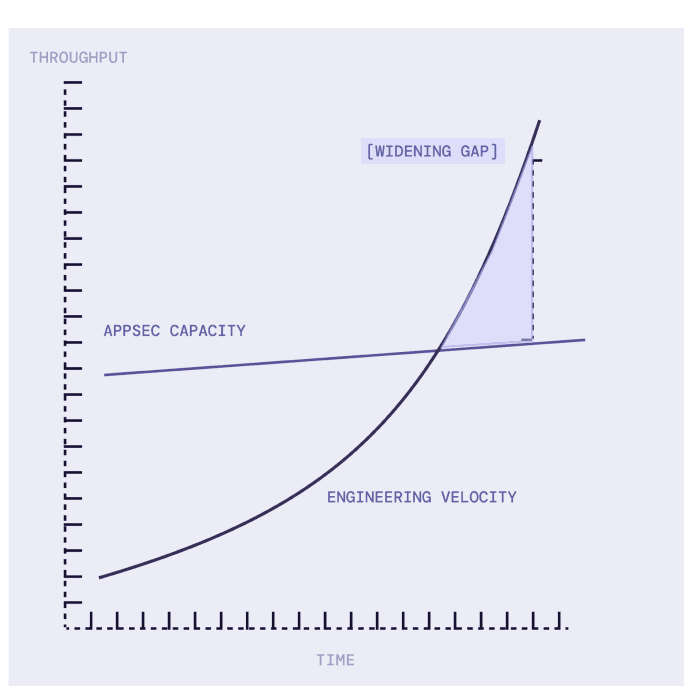
In most insurance organizations, SDRs are still executed as largely manual control activities. Reviewers are expected to assess system architecture by reconstructing context from Jira tickets, Confluence pages, architecture diagrams, and other ad hoc documentation provided at the time of request.
This model creates inherent variability. Design inputs are unstructured, inconsistent, and distributed across multiple systems of record. As a result, the scope, depth, and duration of an SDR depends heavily on documentation quality and reviewer availability rather than on a standardized control process. This makes SDR outcomes difficult to reproduce, validate, or measure across teams.
The operational impact is felt on both sides of the organization.
For application teams, manual SDRs introduce uncertainty into delivery schedules. Review requests may remain queued for extended periods, turnaround times vary widely, and release planning must account for unpredictable security feedback cycles.
In some cases, development teams proceed without completed design reviews in order to meet delivery commitments, increasing downstream remediation risk.
For AppSec teams, the problem is capacity. Development velocity continues to increase as insurers modernize legacy platforms, decompose monoliths, and introduce new digital channels. AppSec headcount does not scale at the same rate.
From a regulatory standpoint, this creates gaps in control execution and evidence. Selective reviews make it difficult to demonstrate consistent application of design-level security controls across systems, as expected under NYDFS and NAIC requirements. Informal prioritization decisions are rarely documented in a way that supports audit scrutiny.
Importantly, this is not a problem of intent or awareness. Development teams generally understand the value of early security engagement, and security teams recognize the importance of assessing design-level risk.
The limitation is structural. Manual SDR processes were not designed to operate at the scale, speed, and documentation variability present in modern insurance development environments.
The result is a persistent tradeoff. Either design reviews become a delivery bottleneck, or review coverage is reduced, weakening the organization's ability to demonstrate preventive controls and increasing the likelihood of architectural risks creeping into production environments. Neither outcome aligns with the regulatory, operational, or risk-management expectations placed on insurers.
The Seezo Approach: Automation That Preserves Your Process
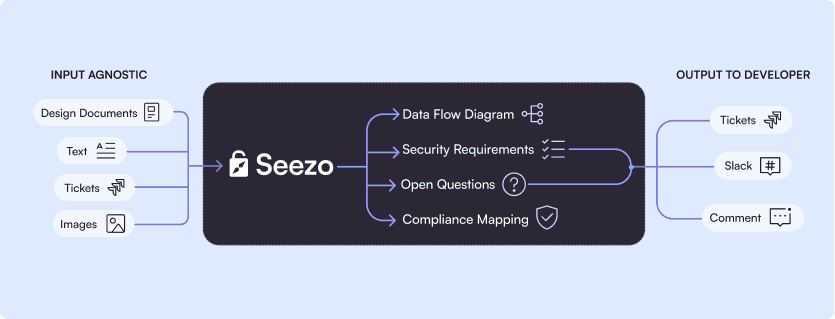
Seezo addresses the scaling limitations of manual SDRs by shifting how design-level security decisions are supported. Where most AppSec tools stop at detection, Seezo supports design-time security decisions, allowing baseline architectural analysis to be applied consistently while preserving human judgment for novel, ambiguous, and high-impact decisions.
A key differentiator is that Seezo adapts to existing development processes rather than forcing teams to adopt new ones. Design inputs are accepted from the tools teams already use, including Jira, Confluence, Google Docs, Slack, PDFs, and architecture diagrams. Reviews are performed against existing documentation, without requiring teams to rewrite or reformat designs for security purposes. Seezo adapts to missing information by automatically identifying gaps and generating targeted questions to complete the security context.
From unstructured inputs to structured, explainable security decisions without reformatting or rework.
Inputs:
Jira Tickets
Confluence Pages
PDFs
Diagrams
Slack Threads
Processing:
Content Extraction
Baseline Analysis
Gap Detection
Outputs:
Security Requirements
Targeted Questions
Mapped Controls
Remediation Guidance
From an AppSec perspective, Seezo performs the baseline architectural analysis that typically consumes most of the review time in manual assessments. This includes identifying authentication and authorization models, mapping data flows involving regulated or sensitive data, evaluating trust boundaries between internal systems and third parties, and checking for required controls such as encryption, logging, and access isolation.
This analysis is driven by a large set of predefined security rules that reflect common architectural risks and control expectations. Context is extracted from unstructured documentation using advances in generative AI, allowing consistent analysis even when inputs vary in format, completeness, or quality.
As a result, SDRs can be applied consistently across all architectural changes, even as review volume increases. Review capacity no longer scales linearly with headcount. Security teams can cover more design changes without adding reviewers, while application teams receive faster and more predictable feedback. Coverage expands beyond a small set of high-risk initiatives to include routine and incremental design changes as well.
Customization: Your Rules, Your Standards
Insurance organizations rarely operate on generic security guidance alone. Internal security standards, risk appetite, regulatory interpretation, and legacy constraints all shape how security controls are applied in practice.
Seezo is built to reflect this reality. During onboarding, the platform learns organization-specific terminology, architectural patterns, and domain language. This is particularly important in insurance environments, where concepts such as policies, endorsements, claims, and binders have precise technical and regulatory implications that generic tools often misinterpret.
Security requirements can be mapped directly to internal standards rather than relying solely on external frameworks. When Seezo identifies an issue, remediation guidance is aligned to the organization's own standards, context, and control language, and tailored to fit existing internal guidance, processes, and security frameworks, making findings immediately actionable for development and AppSec teams.
At the same time, results are mapped to widely recognized compliance and security frameworks such as HIPAA, PCI-DSS, OWASP ASVS, and STRIDE. For compliance-heavy industries like insurance, this dual mapping (industry-specific and company-specific) allows teams to demonstrate consistent internal governance while producing evidence aligned with external audit and regulatory expectations, without duplicating effort.
Workflow Automation: End-to-End Integration
In many insurance organizations, the operational overhead of managing SDRs rivals the analysis itself. Requests are submitted through one system, reviewed in another, and results are communicated back manually, introducing delays, context switching, and inconsistent tracking of outcomes.
Seezo supports end-to-end automation of the SDR workflow within existing systems of record. Design requests can be ingested, analyzed, and returned directly in the tools teams already use, including Google Drive, Notion, SharePoint, Confluence, Jira, Slack, and ServiceNow. This eliminates manual handoffs without requiring changes to how teams initiate or document reviews.
Seezo continuously evolves its integrations to reflect how modern teams work, adding support across documentation repositories, workflow systems, and diagramming tools as environments change. Where needed, Seezo works with customers to build custom integrations aligned to internal tooling and processes.
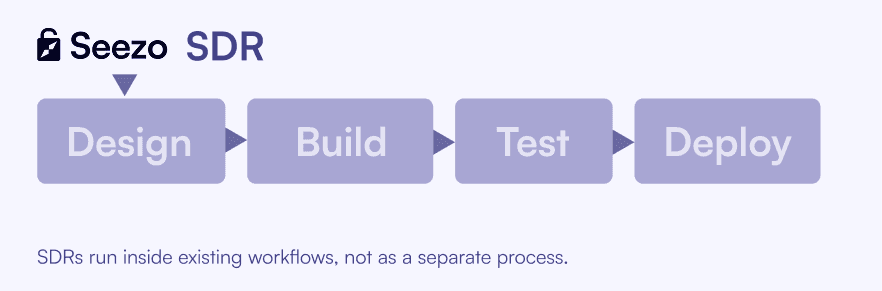
SDRs run inside existing workflows, not as a separate process.
Design → SDR → Build → Test → Deploy
Importantly, this automation does not introduce new workflows or review gates. SDRs run within existing delivery processes, with consistent application, automatic evidence capture, and review capacity that scales with development velocity without slowing delivery.
Case Study
A global specialty insurance and reinsurance organization operating across the United States and United Kingdom needed to perform SDRs consistently as the volume of application changes increased, without delaying releases or allowing changes to ship without completed reviews. Manual SDRs made it difficult to maintain consistent review depth and coverage as development activity grew.
With Seezo, the organization standardized design-level security checks across teams. Baseline architectural analysis was automated, review turnaround times were reduced from 4 days to 2 hours, and SDR coverage expanded without increasing AppSec headcount.
Key Benefits Summary
For Security Leadership
Seezo turns SDRs into a consistent, explainable, and auditable control rather than a collection of individual judgments. Each finding is traceable to specific architectural context, applied security rules, and mapped internal or external standards.
Unlike most AppSec tools that focus on detecting issues, Seezo supports security decision-making. It helps teams determine whether a design meets control expectations, where risk remains, and what remediation is required within the organization's standards, enabling structured and defensible risk acceptance and exception handling.
Because Seezo integrates into existing systems of record, security leaders gain this visibility without introducing new workflows or tools, improving control coverage without increasing operational friction.
For Application Teams
Application teams receive security feedback within the tools they already use, without changing how designs are documented or submitted. There is no requirement to adopt new templates, platforms, or review processes solely for security purposes.
Feedback is specific, contextual, and tied directly to internal security standards. Teams understand why a design decision is problematic in their environment and what changes are required to meet organizational standards, rather than receiving generic findings and remediation guidance.
As a result, application teams experience reduced wait times for security reviews, with baseline analysis completing in around 10 minutes instead of days.
Clear, actionable remediation guidance reduces ambiguity during implementation and leads to fewer back-and-forth cycles between security and development teams, allowing designs to move forward without repeated clarification, rework, or release disruption.
For the Organization
SDRs become a scalable, explainable preventive control that evolves with the organization. Reviews are context-aware, customized to internal standards, and automatically mapped to HIPAA, PCI-DSS, OWASP ASVS, STRIDE, and internal control frameworks, enabling compliance readiness without additional manual effort.
Shifting SDRs from issue detection to structured decision support reduces the risk of architectural security flaws shipping to production. Risks are identified earlier, assessed consistently, and either remediated or consciously accepted with evidence.
Most importantly, security design review capacity scales alongside development velocity without introducing new workflows or slowing delivery, allowing modernization initiatives to proceed without weakening design-level risk management.
Evaluate Seezo in your AppSec workflow
See how design-time security decisions can be applied consistently across a high volume of architectural changes without adding headcount or changing developer workflows.
Book a walkthrough →
Contact Us
Have questions or want to learn more about how Seezo can help your team? Reach out to us directly.
Frequently asked questions
How can insurance companies scale security design reviews without hiring more AppSec engineers?
Insurance companies can scale Security Design Reviews by automating the repetitive architectural analysis that consumes most review time. AI can identify authentication models, data flows, trust boundaries, and missing security controls before a human reviewer steps in. This enables small AppSec teams to review significantly more features while reserving expert time for risk assessment, business context, and final decision-making.
What's the difference between a security design review and a penetration test?
A Security Design Review evaluates a system’s architecture before implementation, while a penetration test evaluates a deployed application by attempting to exploit vulnerabilities. Security Design Reviews identify architectural weaknesses such as insecure trust boundaries or missing security controls, when they’re still easier to fix. Penetration testing validates the security of a running system after those design decisions have already been implemented.
How do Security Design Reviews support insurance regulatory compliance?
Security Design Reviews help insurers demonstrate secure-by-design development by documenting architectural risks, planned security controls, and design decisions before implementation. This evidence supports compliance with frameworks such as the NAIC Insurance Data Security Model Law, NYDFS Part 500, GLBA, and PCI DSS, all of which emphasize risk assessment, preventive controls, and secure system development.
Why do manual security design reviews create audit risk for insurers?
Manual Security Design Reviews often result in inconsistent review coverage because they depend on reviewer availability and individual expertise. As application portfolios grow, teams naturally prioritize only the highest-risk systems, leaving many architectural changes undocumented. Consistent review coverage and traceable evidence are easier to demonstrate during audits than ad hoc, expert-driven review processes.
Can AI automate security design reviews without replacing human judgment?
Yes. AI can automate much of the first-pass architectural analysis by identifying security-relevant components, mapping data flows, evaluating trust boundaries, and checking designs against predefined security requirements. Security teams remain responsible for validating findings, considering business context, and making final risk acceptance decisions. AI increases review capacity, it doesn’t replace security expertise.